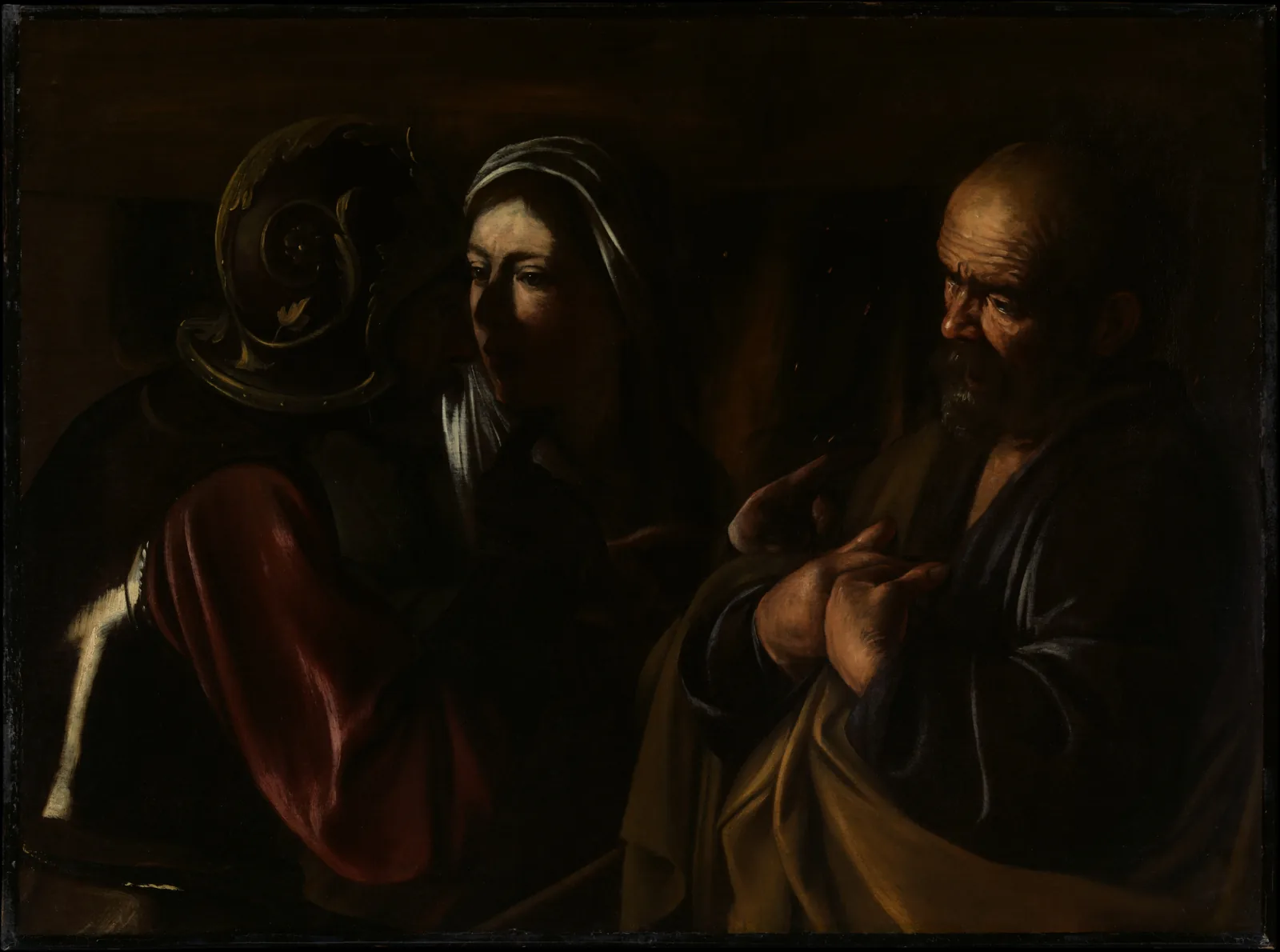
A shaft of light draws three faces out of the darkness. An older woman points towards Peter; a soldier turns to him. Peter holds his hands to his chest, as though saying, “Not me.” In Caravaggio’s The Denial of Saint Peter, painted in 1610, there is no great crowd. There are just three people, an accusation, and the weight of a reply. The artist painted it far from Rome, while his own future remained uncertain.
The life that broke in Rome
During his Roman years, Caravaggio had changed the look of religious painting. Rather than ideal figures, he showed saints in recognizably human bodies, under sharp light and deep shadow. Success did not keep him away from street violence. On 28 May 1606, a fight in Rome ended with the death of Ranuccio Tomassoni. Accounts differ on what provoked it; the event cannot responsibly be reduced to one romantic tale of jealousy. Caravaggio fled the city.
Leaving Rome meant more than changing addresses. He departed the centre of his commissions and reputation. The route ahead would take years: Naples, Malta, Sicily, and Naples again. He painted at every stop. Flight did not end the work; it changed the circumstances in which the work was made.
Naples: A new city and new commissions
Caravaggio’s reputation preceded him in Naples. The Met’s chronology places him there in 1606–07 and again in 1609–10. Major religious commissions show that a painter in exile could still be in demand. In these works, light does more than illuminate a scene. It gathers our attention around a hand, a face, or the instant of a decision. Darkness does not erase the world outside that spotlight; it makes us feel its presence.
It is tempting to turn every shadow from these years into evidence of personal guilt. Yet light and shadow had already formed a powerful part of his art in Rome. We can see how that visual language developed during his flight without treating each painting as a literal confession about his inner life.
Rise and fall in Malta
In 1607 he went to Malta and was admitted to the Knights Hospitaller. The order offered the prospect of influential protection away from Rome. But another fight led to his imprisonment. According to Heritage Malta, he escaped from custody at Fort St Angelo in 1608. He needed somewhere else to go once more.
The Malta episode resists a simple ascent. His skill opened doors while his conduct closed them again. The paintings continued, and so did the journey. Sicily was next.
Large canvases and charged silences in Sicily
He made large religious paintings for Syracuse, Messina, and Palermo. The Met dates his Sicilian period to 1608–09. In these works, the space and shadow around the figures often feel as consequential as the event itself. We stand before miracles and suffering as witnesses rather than distant spectators.
We should not read the images as entries in an artist’s diary. A painting is not a direct record of everything its maker experienced. But the compressed gestures and selective illumination in Caravaggio’s late work intensify the story. Who looks at whom, and who conceals what, matters more when so much else recedes into darkness.
Back to Naples, and Peter’s gaze
Caravaggio returned to Naples in autumn 1609. The Met records an attack outside a tavern that October, which left his face injured. The identity and motives of the attackers do not support a neat, certain scenario. What we do know is that he kept painting. The Denial of Saint Peter, dated 1610, is now in the collection of the Metropolitan Museum of Art in New York.
In the biblical account, Peter denies knowing the arrested Jesus three times. Caravaggio does not stage this as a grand historical spectacle. The woman’s hand conveys the accusation; the soldier listens; Peter’s hands form something like a defence. The illuminated faces are close, but trust is absent. The tension lies in whether one person will tell the truth.
It is tempting to identify this Peter with Caravaggio himself. The museum dates the picture to 1610; it does not present the work as a documented personal confession. A more careful reading sees the human uncertainty in the scene without letting biography stand in for the painting.
The last journey
Hoping to return to Rome, Caravaggio travelled north but never arrived. He died at Porto Ercole in July 1610. Details of his final days remain debated by historians. To narrate a definitive death scene would claim more than the evidence permits. The Met identifies The Martyrdom of Saint Ursula as his last painting, a reminder that he was still working near the end.
The years of flight live on through more than a sequence of violence and loss. Their paintings still draw us uncomfortably close. Looking at Peter’s hands, the woman’s gesture, and the soldier’s doubt, we encounter more than an artist’s legend: people inside the darkness are still making choices. Caravaggio’s light makes that moment visible.
For another perspective on this art and its history, read Van Gogh’s final years: Beyond the crows.