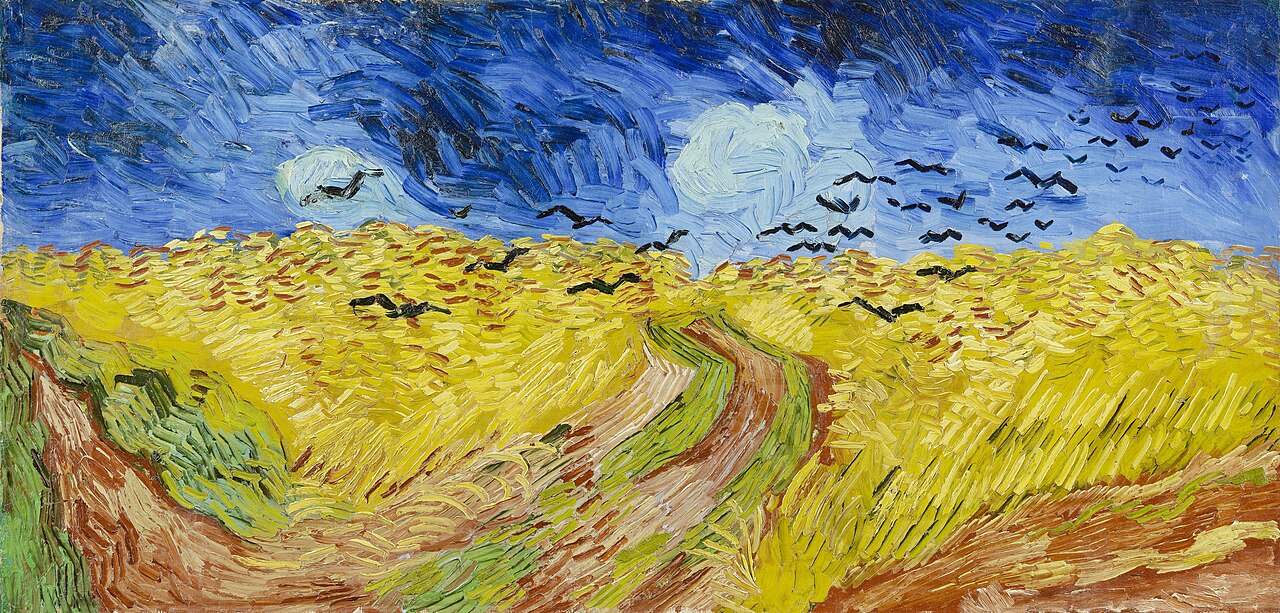
A yellow field opens into three paths. Crows cross its surface, while the sky seems to press down over the wheat. Looking at Van Gogh’s Wheatfield with Crows, it is tempting to read the image as an artist’s final message. For years, the painting has been introduced as his last. The Van Gogh Museum calls that claim a persistent myth. The canvas belongs to the final weeks of his life, but no evidence establishes it as his last painting.
A new beginning in Auvers
Vincent van Gogh arrived in Auvers-sur-Oise, near Paris, on 20 May 1890 after leaving the asylum at Saint-Rémy. He hoped to work again and to be closer to his brother Theo. In the village he met Dr Paul Gachet, a physician who was also an art collector and amateur printmaker. Van Gogh painted Gachet’s portrait and, with the doctor’s help, made the only etching of his career.
The brevity of the Auvers period is deceptive. According to an exhibition organized by the Musée d’Orsay and the Van Gogh Museum, he produced 74 paintings and 33 drawings in a little over two months. He painted the village houses, gardens, people, and the surrounding fields. To tell the story of these months only as a march towards his death obscures both the pace of his work and his willingness to experiment.
It is easy to picture him arriving in the village and walking alone among fields. The days also held letters to his brother, conversations with a doctor, encounters with neighbours, and worries about how his painting might continue. These works were made among such relationships and questions. A portrait records an encounter with another person; a landscape asks us to imagine the hours spent looking and working outdoors. His last months become more interesting when they are allowed to contain ordinary life as well as extraordinary art.
The meeting with Gachet is especially revealing. The doctor’s connections to artists offered Van Gogh care and a chance to talk about pictures. The Metropolitan Museum of Art records that Van Gogh also etched Gachet’s portrait and hoped to pursue more work in the medium. This modest plan for future work matters. In these final weeks, he had not stopped looking for new ways to make an image.
What can colour tell us?
Wheatfield with Crows is unsettling: a dark blue sky, bright yellow wheat, paths that split and seem to disappear. It is reasonable to feel fear or loneliness when looking at it. But a feeling prompted by an image is not a precise record of the painter’s thoughts on the day he made it. A stormy sky cannot, on its own, serve as a biography.
In a letter to Theo in early July, Van Gogh described broad wheatfields beneath troubled skies. He said that he had tried to express sadness and profound loneliness, but also spoke of the countryside as healthy and restorative. Both responses could belong to the same landscape. Reading the paintings solely as predictions of despair erases the tension that appears in his own words.
Nor did every painting from Auvers sound the same note. The village church rises through animated lines and colours; gardens and houses appear from shifting points of view. Rather than repeating one image, Van Gogh kept finding different ways to make the world in front of him visible. His final period was tragic, but it was also extraordinarily productive.
There was a material side to this work as well: canvases, paint, the possibility of continuing to work, and his brother’s financial support were real concerns. His July letter conveys his anxiety for Theo and Theo’s wife Jo. Van Gogh wrote of the brush almost falling from his hand, and of going back to work and completing large canvases. The letter is moving because it does not preserve a single, tidy mood. Fear, affection, and work appear together on the page.
Matching a colour in a painting to an event in a life can become an irresistible game. Yellow might be declared hope, blue sorrow, and a crow death. These are interpretations, not a dictionary the artist left behind. Thick paint makes the wheat almost tactile and gives the whole landscape its movement. The way the canvas was made can be as compelling as any symbol we might find in it.
Which painting came last?
The story that Wheatfield with Crows was his final canvas has an almost irresistible dramatic logic. The Van Gogh Museum, however, explicitly rejects it as a myth. Museum research instead points to Tree Roots as a possible final work. Its tangled roots, trunks, leaves, and patches of earth nearly dissolve into an abstract pattern. It offers no easy concluding statement either.
Asking which canvas he worked on last can illuminate the chronology. Treating every canvas as a coded farewell is another matter. Before turning this wheatfield into a prophecy, we can look at what is actually painted: the movement of the brush, the collision of yellow and blue, and the paths opening under the sky. The painting does not need to be a secret message to matter.
The last-painting myth hides another question: if Tree Roots was in fact his final work, would Wheatfield with Crows be any less powerful? Of course not. A picture’s force does not come from its position on a calendar. The field remains a restless landscape in which the colours press against one another and the paths draw our eye inward. Knowing that another work may have followed it does not erase that feeling. It merely prevents one interpretation from becoming the only one.
The end of a life is not the whole of an artwork
Van Gogh shot himself on 27 July 1890 and died in Auvers two days later, on 29 July. He was 37. Theo was with him in his last days. His mental distress was real, and his death was tragic. Yet interpreting all of his art through that death leaves out his curiosity, his discipline, and the range of emotions held in the paintings he made at Auvers.
We do not know where the paths in this field lead. Perhaps that is part of its strength: the painting resists being shut inside one emotion or one biographical explanation. In Van Gogh’s final months there was sadness and there was work; there was loneliness and there was an intense interest in nature. We may see an ending in the crows. If we keep looking, we also see the hand of a painter still making something new.