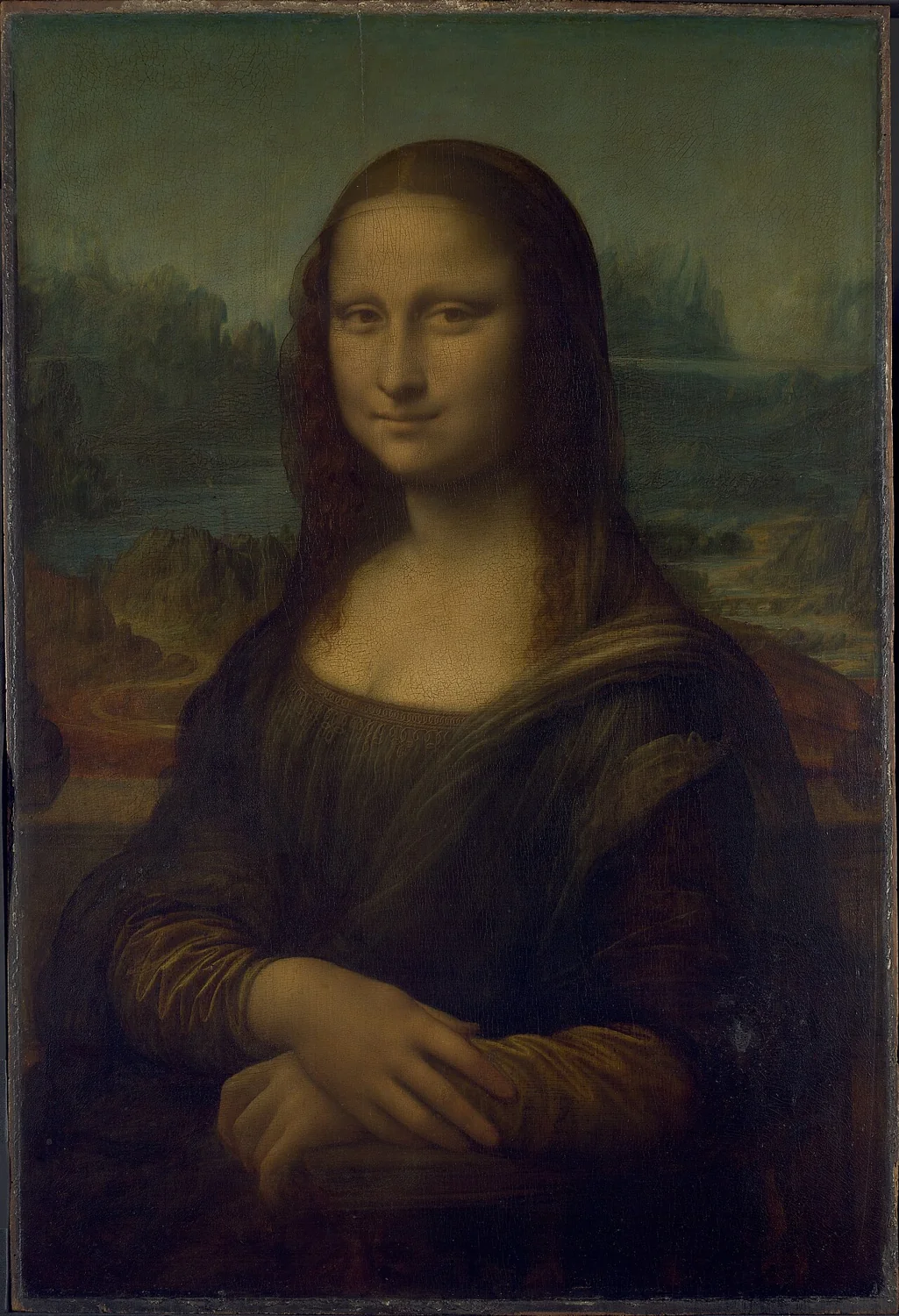
On 21 August 1911, a wall in the Louvre was empty. The painting that belonged there was Leonardo da Vinci's Mona Lisa. Newspapers carried the news, and visitors came to see the space she had left behind. The scene invites a neat conclusion: the world's most famous painting was born that morning. But the theft was a noisy new chapter in a story of admiration that had begun centuries earlier.
A woman, a portrait, a question
The Louvre identifies the sitter as Lisa Gherardini, wife of the Florentine merchant Francesco del Giocondo. The Italian name La Gioconda comes from this connection. Leonardo began the portrait in the early sixteenth century. Its making cannot be reduced to one date: the Louvre dates the work to 1503–1519 and records that Leonardo kept it throughout his life. The details of its original commission deserve care rather than an invented certainty.
We are looking at a real person's portrait, yet the picture does not behave like a biographical document. Lisa's hands rest quietly; her gaze meets ours; behind her, paths and rocks seem to belong to an unfamiliar world. Leonardo's arrangement asks us to look both at a person and at the act of painting. The sitter's identity is part of the story, but the picture's pull begins on its painted surface.
Why can't we pin down the smile?
Look closely for a hard line around the mouth and you will struggle to find one. The Louvre points to Leonardo's use of sfumato: delicate transitions between colour, shadow, and light soften the outlines. The corners of the lips, the cheeks, and the eyes refuse to settle into a sharp border. The face may seem to change as we look. Its mystery owes much to paint and light, without requiring a supernatural secret.
The landscape takes part in the effect. Winding paths and distant water meet the calm figure in the foreground. The expected boundary between a person and a place feels less secure. The Louvre includes this imaginative landscape, as well as the smile, among the painting's attractions. We return to the face not only to ask whether she is smiling, but also to see how the world around her shifts our sense of it.
The original is smaller than many visitors expect. The Louvre measures the poplar panel at approximately 79.4 by 53.4 centimetres. Someone who knows it mainly from large reproductions may be startled in the gallery. But the power of a picture does not depend on its size: within that panel, hands, face, and landscape make a scene that does not end at a glance.
From Leonardo to the king to the museum
The painting's journey also shaped its reputation. Leonardo kept it; according to the Louvre, François I of France probably acquired it around 1518. It entered the French royal collection and, centuries later, became one of the Louvre's most sought-after works. It needed no overnight sensation to matter. Its technique and its place in a major collection were known long before the theft.
This history matters because a popular version of the story sometimes suggests that nobody cared about the portrait until 1911. The Louvre describes it as a star already when it entered the museum. The theft did not create the painting's value. It carried the name and image of a valued painting to a far wider audience.
When an empty wall made headlines
The man who took the painting in 1911 was Vincenzo Peruggia, a former Louvre glazier. It remained missing for more than two years. When Peruggia tried to sell it to an art dealer in Italy, the portrait was recovered in 1913 and returned to France. The episode had the rhythm of a crime story: disappearance, prolonged search, unexpected return. Newspapers kept naming the painting, making its face familiar even to people who would never set foot in the museum.
It helps to distinguish two kinds of fame here. Respect within art circles grew from the painting's artistic achievement and history. Newspaper coverage turned it into a story that almost anyone could follow. These do not cancel each other out. Remembering the theft vividly does not mean the painting had been invisible before it.
Across the Atlantic
Another chapter unfolded in the United States. The National Gallery of Art records that the Mona Lisa was exhibited first in Washington and then in New York in early 1963. The Washington presentation ran from 9 January to 3 February; New York followed from 7 February to 4 March. A diplomatic reception at the White House, long visitor lines, and intense publicity made the tour an international cultural event. A portrait that may once have been intended for one household had become a meeting point for crowds.
It is hard to imagine the effect of such a journey without photographs, news reports, and reproduced images. The more places the face appeared, the more people wanted to encounter the original. In the museum, its real dimensions and painted surface can still surprise someone who thinks they know it from reproductions. Copies do not necessarily diminish curiosity about the work itself.
The face behind the glass
Today the Mona Lisa hangs in the Louvre's Salle des États behind protective glass. The Louvre explains that temperature and humidity are carefully controlled to preserve its poplar panel. From within the crowd the painting can look small, a brief encounter between heads and phone screens. That scene belongs to its present life, too. We look at a portrait and at the many people who have come to look with us.
So how did the Mona Lisa become so famous? There is no single cause. Leonardo's subtle technique, the painting's path through a royal collection, the publicity of the 1911 theft, and the great exhibitions of 1963 all contributed. Looking again at that smile, we may remember something else: a painting's fame grows where what we see in it meets the stories people tell beyond its frame.