In the early sixteenth century, Florence asked two artists the same question: how do you put a city's history on a wall? On one side of the great council hall would be Leonardo da Vinci's Battle of Anghiari; on the other, Michelangelo's Battle of Cascina. Had they both been completed, the paintings might have confronted one another across the room. But the curious part of the story is that neither project reached its intended finish.
Two kinds of power in Florence
Leonardo was born in 1452, Michelangelo in 1475. In 1504, one was past fifty; the other was twenty-nine. Leonardo had spent years moving among painting, engineering, anatomy and the observation of nature. Michelangelo had made his name by drawing figures out of marble and had completed his monumental David in 1504. Both were deeply interested in the human body, yet they asked different things of it.
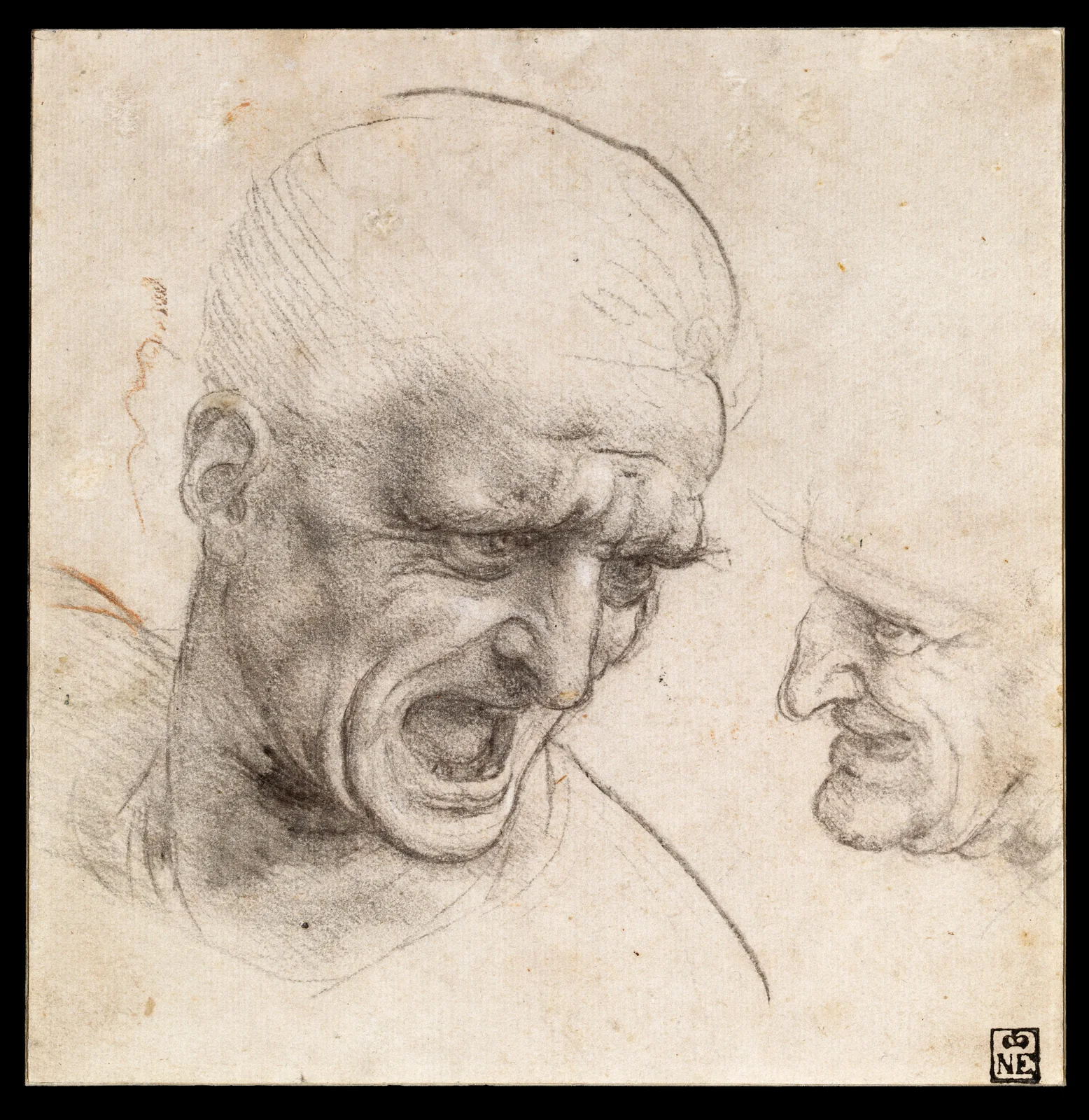
For Leonardo, the tension in a face could reveal the shape of fear and anger. For Michelangelo, a body's pose could be a dramatic language in itself. This does not make them simple opposites. It does, however, help us see why their designs for the Florentine commission look so different. The same public room was about to hold two distinct visual ideas.
Michelangelo's David had been placed in Florence's civic space. It showed that the young artist could create more than a technically impressive sculpture: he could give a city a monumental figure. Leonardo, meanwhile, was an established master who had long explored movement, light and emotion in painting. The great hall brought them onto the same scale. What was at stake was a public image of Florence's past, with the reputations of both artists attached to it.
The battleground: Palazzo Vecchio
Florence's government commissioned Leonardo to depict the Battle of Anghiari for the great council hall in the Palazzo della Signoria, now known as Palazzo Vecchio. Michelangelo was subsequently assigned the Battle of Cascina. The subjects commemorated victories from the city's history. Large designs for the same room would inevitably invite comparison, even if no official winner was to be named.
Leonardo turned to the violence of the 1440 clash at Anghiari. In surviving studies, soldiers' faces tighten and the movements of men and horses knot together. Later copies preserve something of the struggle at the composition's centre. His battle appears less like a calm celebration of victory than a storm that draws human and animal bodies into its force.
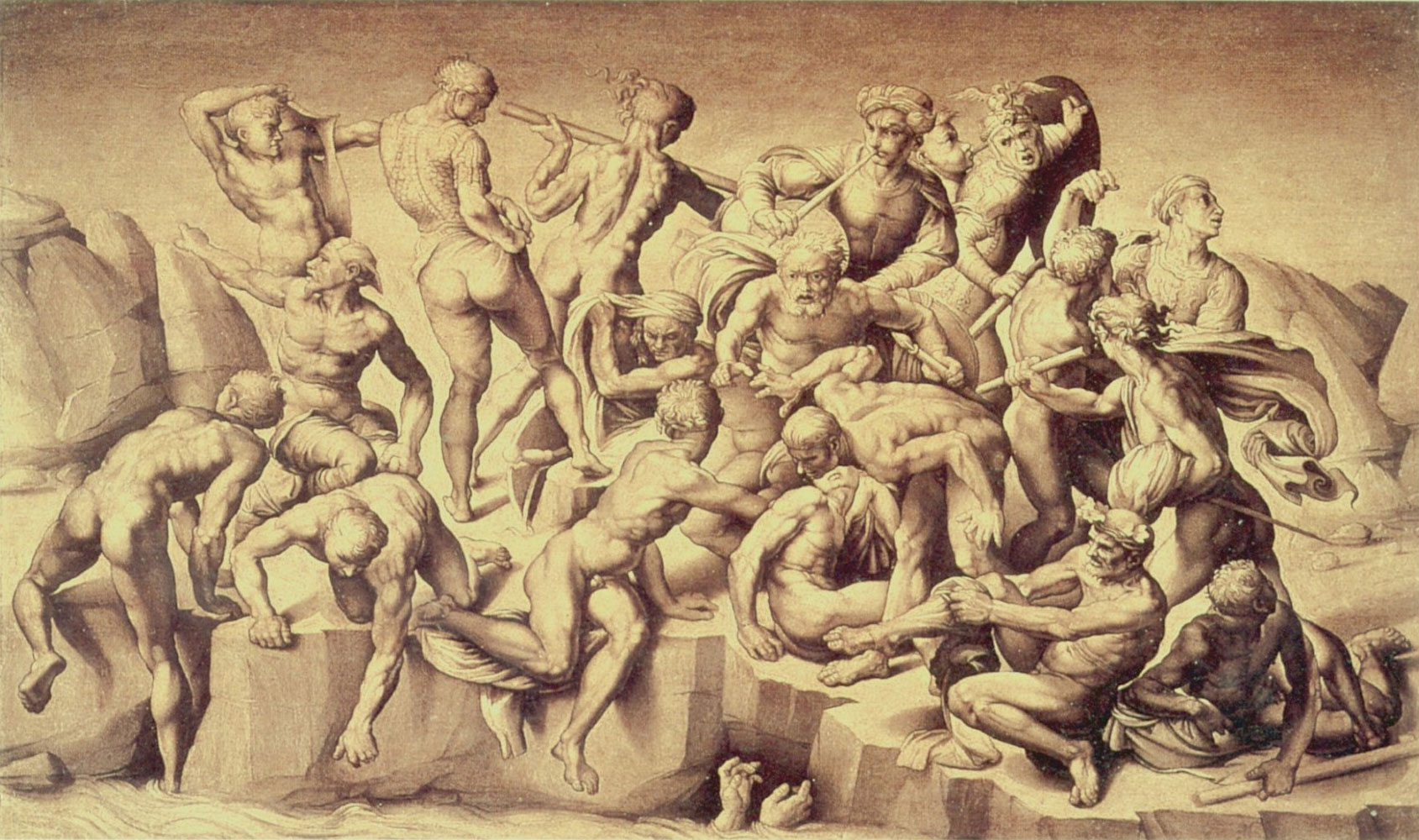
Michelangelo chose another kind of moment. His soldiers are bathing near Cascina when an alarm calls them into action. Some pull themselves from the water; others bend, turn or reach for their weapons. By choosing the instant before combat, he could show the body in a remarkable range of positions. The tension begins in a sudden physical response, before the battle itself is visible.
Put the scenes beside each other in your imagination. Leonardo pushes us into the middle of the clash. Faces, horses, arms and weapons crowd a single movement. Michelangelo stretches the threshold just before fighting starts. A soldier reaching for his clothes can command as much attention as a warrior in combat. This reading rests on the drawings and copies that survive; it does not pretend that we can know every intention the artists had.
When the contest remained on paper
Both artists prepared large, full-scale drawings known as cartoons. These were designs used in transferring an image to a wall. Yet the splendid hall we imagine never came to be. Leonardo left his mural unfinished; Michelangelo's design was never executed on the wall. Neither original cartoon survives today.
It is tempting to call that a failure. But a work's influence is not measured only by its finished state. Younger artists studied these designs and copied their figures to learn about anatomy and movement. The sculptor Benvenuto Cellini later referred to the two cartoons as the “school of the world,” a phrase that conveys their importance to a generation. According to a story recorded by Vasari and cited by the Uffizi, the fame of the cartoons drew the young Raphael to Florence. This is a historical account of their reputation, rather than proof of some imagined conversation among the three artists.
When we look at Sangallo's later copy after Michelangelo, we encounter two moments at once: a lost design from the early 1500s and a later artist's attempt to preserve its figures. Leonardo's study of warriors' faces, meanwhile, offers a glimpse of a painting in the making. Both are precious evidence. Neither allows us to claim that we are looking at the two original murals as they would have appeared across the room. In art history, “lost” can describe a gap surrounded by traces.
Rivalry, legend and what remains uncertain
The relationship between Leonardo and Michelangelo is often retold as if it were a film: two geniuses throwing down a challenge, two opposing walls, one definitive victor. The records and objects suggest a subtler story. Their commissions brought them face to face in the same public project. Their contemporaries compared them, and their designs took strikingly different approaches. But not every sharp remark or dramatic anecdote attributed to them has equally solid evidence. We need not invent a quarrel to make the situation compelling.
The clearest expression of their rivalry lies in the choices they made. Leonardo moved towards rage within battle; Michelangelo towards the body's movement in the moments before it. One gave particular force to the expression of a face, the other to a figure's physical energy. Neither artist should be reduced to a single quality: their interests were far wider than these two designs.
Who was greater? The question is seductive, but there was no judgement based on two completed paintings. Nor did the artists who followed have to pick just one side. A younger painter such as Raphael could study Leonardo's paintings and drawings alongside Michelangelo's sculpture and designs in Florence. Art sometimes changes through the circulation of different answers to the same question, rather than through a clear victory.
Why does it matter now?
We cannot visit Florence and see the two finished murals facing one another. Leonardo did not finish his painting; Michelangelo's was never made on the wall. What remains are studies, later copies and written accounts. To a storyteller, that may seem like a frustrating absence. To art history, it is also a powerful kind of trace: even an unrealised work can change how other artists see.
Perhaps the encounter stays with us precisely because there is no final score. Leonardo and Michelangelo left two ambitious ways of imagining the body, movement and emotion in battle. What is missing from the walls of Florence continued to live in the drawings of those who followed. Sometimes the most powerful scene in a story is the one that was never completed.