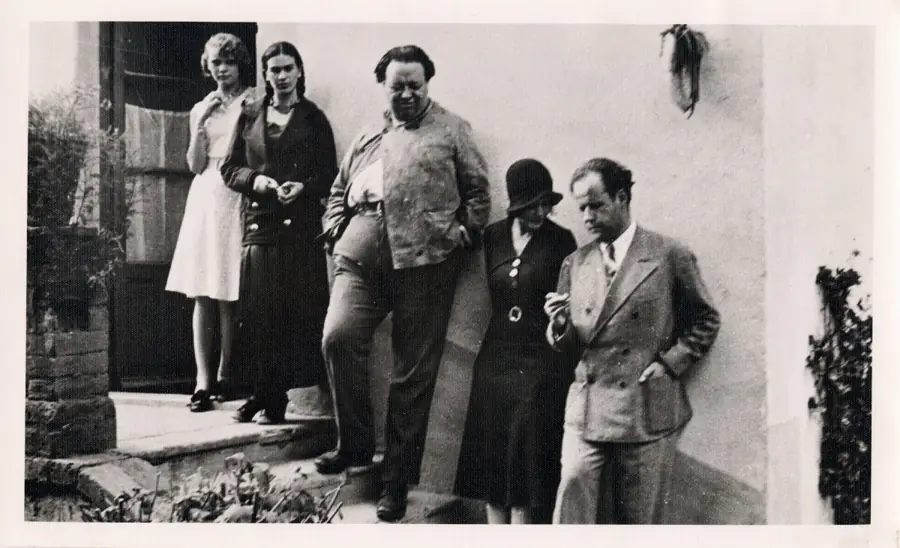
The relationship between Frida Kahlo and Diego Rivera is often reduced to one word: passion. Yet that word cannot explain decades of closeness between two distinct artists. Their story held admiration, infidelity, separation, politics, illness, and the need to create at the same time. They returned to one another, but they never became a single artist or a single identity.
1929: Two painters marry
Frida grew close to Diego in the art and political circles of Mexico in the late 1920s. They married on August 21, 1929. Diego was already one of the country’s best-known muralists; Frida was a young artist who had turned more intensely to painting after a devastating bus accident.
Diego’s public murals placed revolution, labor, and Mexican history on monumental walls. Frida explored her body, pain, and identity in smaller, deeply personal paintings. Although they shared a life, their art never became a copy of the other’s.
A portrait of a marriage
Frida’s 1931 painting Frieda and Diego Rivera is among the couple’s best-known images. Diego dominates the composition with his large figure and palette, while Frida depicts herself at a smaller scale. The work is more than a wedding portrait: it makes visible both her position as a wife and an artistic identity still taking shape.
Diego’s commissions took them to San Francisco, Detroit, and New York. These journeys introduced Frida to international art circles, yet her work gradually emerged from the shadow of Diego’s fame. Her exhibitions and the direct personal language of her paintings established her as an independent artist.
Between closeness and rupture
Their marriage was shaken by affairs on both sides and severe conflicts. Turning this period into a simple legend of “great love” erases Frida’s hurt and her effort to build a life of her own. In her paintings, Diego could appear as a beloved figure, an idea lodged within the body, or a source of loss.
They officially divorced on November 6, 1939. Frida’s 1940 Self-Portrait with Cropped Hair, as MoMA notes, carries the pain of separation alongside a desire for financial and personal autonomy. Seated in a man’s suit amid her cut hair, she constructs an image of herself beyond the role of wife.
1940: A second marriage
The separation did not last. Frida and Diego married again in San Francisco on December 8, 1940. Two ceramic clocks displayed at Casa Azul record the dates of their divorce and remarriage, placing the breaking and rebuilding of their bond inside the everyday memory of the house.
Their second marriage did not erase what had happened. Frida placed importance on keeping her own income and working space. Diego continued to speak openly about his admiration for her art. They remained central to each other’s lives, though that center was never calm or uncomplicated.
What remained at Casa Azul
Frida died at Casa Azul on July 13, 1954. Diego supported the process of turning the house into a museum, and Museo Frida Kahlo opened in 1958. Today the house holds clothing, working materials, and objects from their shared life alongside artworks.
What makes Frida and Diego’s story memorable is not perfection. It is the way two powerful artists loved, hurt, and influenced one another while remaining separate voices. Their relationship is less a love story than a difficult partnership in which art and life could never be fully separated.